





From metal to fine textures, an article to help you understand the wire drawing process
In the jewelry industry, where light luxury and minimalist styles are prevalent, brushed metal jewelry has become a popular choice for daily wear and commuting due to its delicate texture, warm matte finish, and understated sophistication. Unlike mirror-polished pieces that dazzle with brightness, brushed metal imparts a unique texture through uniform lines, offering durability, resistance to dirt, and minimal fingerprint visibility, while enhancing the overall quality and elegance of the jewelry. Many people appreciate the refined look of brushed jewelry but rarely understand the rigorous and complete production process behind it. Today, we will provide a detailed introduction: how exactly is the brushed metal jewelry process carried out, and how does it step-by-step create such a fine texture?
What is the Brushed Metal Jewelry Process?
Brushing is one of the important surface treatments for jewelry. It involves using specialized tools to uniformly friction the metal surface, creating ordered, fine, and even linear textures. These textures can be straight, slightly curved, dense, or soft, ultimately resulting in a matte and lustrous effect. This makes the metal more layered and textured, with an understated and unassuming demeanor.
Brushing is commonly used for jewelry made from materials such as silver, K-gold, titanium steel, and alloys. It can be applied to necklaces, bracelets, rings, and earrings, producing simple yet grand designs with excellent versatility. It is also a frequently used surface treatment method for high-end jewelry.
Complete Brushing Process: Seven Steps from Blank to Finished Product
- Blank Refinement and Basic Polishing
Before brushing, all jewelry must undergo basic refinement. Artisans first process the cast blanks, removing gates, burrs, and deformed areas, then use files for rough shaping.
Next comes multi-stage sandpaper polishing: progressively from coarse to fine sandpaper to polish the metal surface, ensuring it is flat, smooth, free of pits and scratches. The cleaner the base refinement, the smoother and more uniform the brushed texture will be later. This step directly determines the fineness of the brushed texture.
- Fixation and Positioning: Ensuring Uniform Texture Direction
To prevent skewed or messy textures during brushing, artisans must precisely fix the jewelry in clamps during processing. Different types of jewelry, such as rings, bracelets, and pendants, have specific fixation methods. Artisans must ensure the jewelry does not move or shift during processing.
The purpose of fixing the jewelry during brushing is singular: to keep all textures aligned in the same direction and depth, achieving a neat and sophisticated visual effect.
- Brushing Processing: Hand Brushing vs. Machine Brushing
The core steps of wire-drawing are divided into two types, with slight differences in effect and texture.
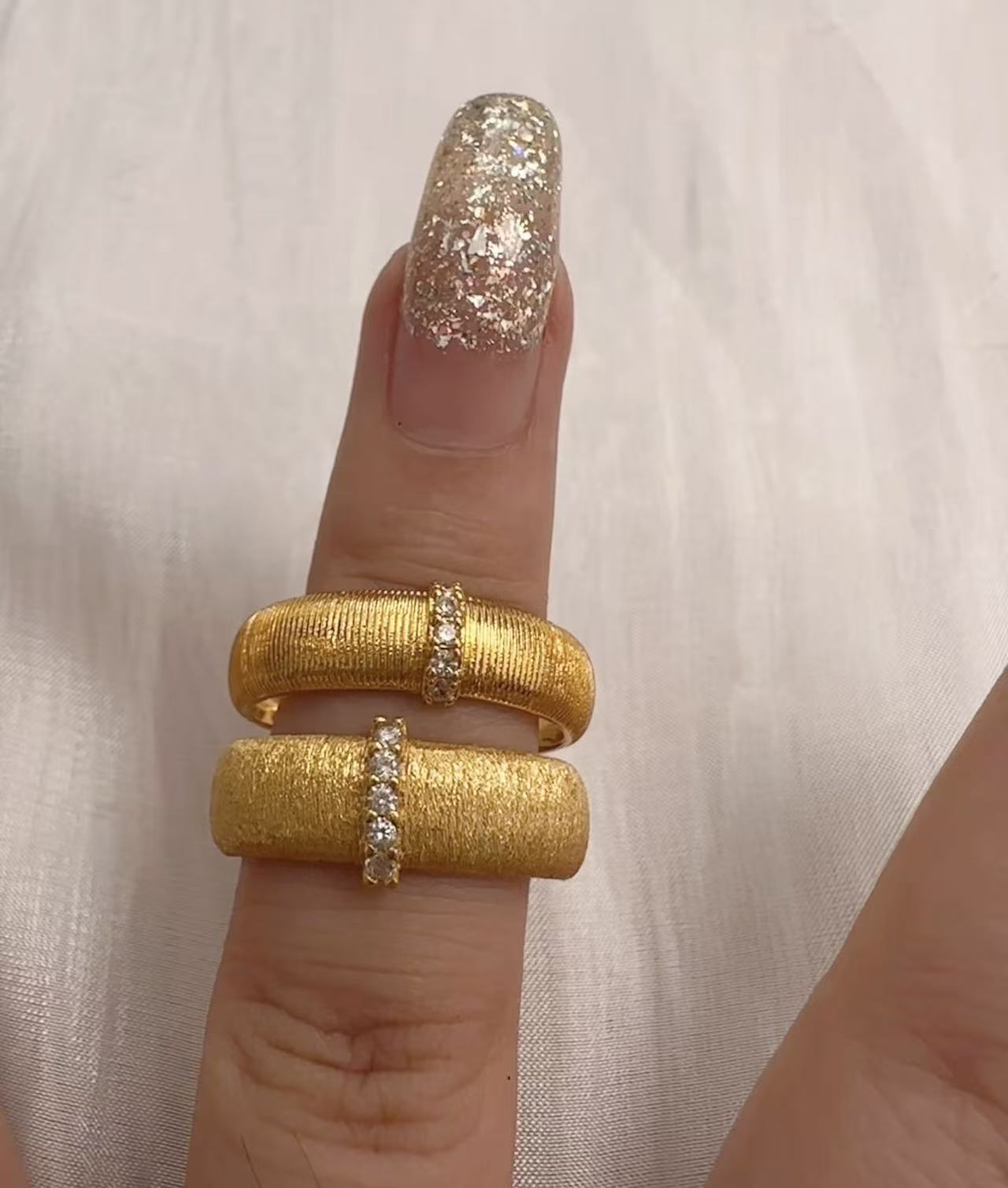
The first method is machine wire drawing: it is highly efficient with extremely uniform patterns, suitable for mass production. Using wire drawing wheels, belts, or CNC equipment, it involves unidirectional friction with stable force and speed, resulting in consistent depth and clean lines, making it ideal for minimalist and modern jewelry designs.
The second method is hand wire drawing: it offers more warmth and artistic appeal. Artisans manually create the texture by hand using wire drawing knives, oil stones, or fine sanding tools, controlling the force based on feel and experience. Each texture varies slightly, enhancing the handmade quality, and is better suited for high-end custom and lightweight, niche pieces.
For example, as shown in the image, the one above is machine-drawn, and the one below is hand-drawn.
Regardless of the method, strict adherence to unidirectional single-pass forming is followed to prevent texture confusion caused by back-and-forth friction.
- Texture Adjustment and Detail Trimming
After wire drawing, artisans inspect the lines for uniformity, check for broken patterns, and ensure edges are not sharp. They then make minor adjustments to uneven areas and inconsistent texture depths to achieve a more unified and comfortable overall texture.
Detail trimming is crucial to ensure the wire-drawn jewelry slides smoothly without scratching clothes or skin when worn.
- Deep Cleaning: Removing Metal Dust and Impurities
Metal powder, oil stains, dust, and other residues often linger in the crevices of wire-drawn textures, which must be thoroughly cleaned. The usual cleaning method involves using an ultrasonic cleaner with professional cleaning solution to vibrate and remove deep-seated impurities from the texture grooves, resulting in clearer lines and cleaner metal, thus presenting the most authentic wire-drawn matte finish.
- Anti-Oxidation and Protective Treatment
To prevent wire-drawn jewelry from oxidizing, discoloring, and to ensure the texture lasts longer, artisans typically proceed with protective treatments:
Silver jewelry commonly uses rhodium plating; K-gold and alloys often use vacuum electroplating, glazing, or anti-oxidation protective layers.
This step does not alter the wire-drawn texture but significantly enhances wear life, allowing the jewelry to maintain a delicate and sophisticated appearance over time.
- Final Quality Inspection: Comprehensive Acceptance of Texture, Luster, and Feel
Qualified wire-drawn jewelry must meet the following criteria:
Uniform texture direction with even depth, no messy scratches, smooth edges, clean surface, and a matte, warm luster.
Only after successfully passing quality inspection is a delicate and sophisticated wire-drawn jewelry piece considered truly complete.
Three Major Advantages of Wire-Drawing Jewelry
- Sophisticated and Low-Key: The matte, warm finish is more understated than polished, exuding a natural light luxury aura.
- More Practical for Daily Wear: It is less likely to leave fingerprints and show scratches, making it more convenient to wear.
- Stronger and More Durable Texture: The line texture enhances metal layers, giving the metal a unique texture that becomes more appealing with wear.
The metal wire-drawing process may seem simple, but every step tests craftsmanship and standards. From base polishing to texture formation, from cleaning to protection, precise processes are required to achieve such a delicate and uniform texture.
If you prefer a minimalist, refined, understated, and versatile jewelry style, brushed metal jewelry is undoubtedly your ideal choice. It is not showy or ostentatious, yet through its unique texture, it embodies the most enduring everyday luxury aesthetic.


